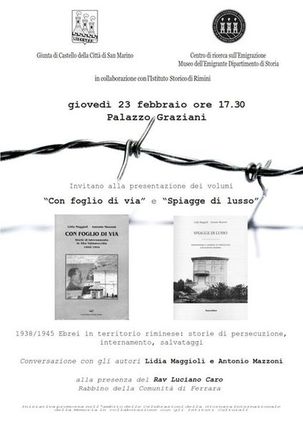
As part of the Holocaust Remembrance Day initiatives, on Thursday, February 23, at 5:30 p.m., at Palazzo Graziani (V.le Lo Stradone, City of San Marino), the Emigration Research Center (Department of History, University of San Marino) and the City Council, together with the Rimini Historical Institute, are promoting the presentation of "Luxury Beaches" and "With Traveling Papers," by Lidia Maggioli and Antonio Mazzoni, dedicated to the experiences of Jews on the Adriatic coast and in Montefeltro. These stories of persecution, internment, and rescue during the Holocaust, which also affected the Republic of San Marino and the Rimini area, are presented. "LUXURY BEACHES" reconstructs the consequences of the racial laws on the lives of Jewish citizens residing or vacationing along the Adriatic coast. The authors' careful historical reconstruction is based on archival documents, testimonies, diaries, and memories of the protagonists. This is a chapter in local history that fits into the context of the entire Italian peninsula and Europe, as many of the Jews from Bellaria to Cattolica reached the Adriatic coast seeking refuge from Nazi-Fascist persecution. From the enactment of the Racial Laws in Italy between 1938 and 1944, Jewish citizens who were residents or displaced on the Adriatic coast, or who had a holiday home there, suffered abuse and real persecution, experiencing the concrete consequences of racial hatred, but in some cases also the generosity of those who disobeyed racist legislation and offered assistance that often meant salvation. A second book, "WITH TRAVEL PAPER," reconstructs the painful stories of Italian and foreign Jewish citizens who, from 1940 to 1944, were forced to endure months and years of forced residence in the municipalities of Pennabilli, San Leo, and Sant'Agata Feltria, stages of a segregation that led to other towns in the Marche region and the Italian peninsula. The family stories narrated bring the reader into direct contact with the reality of deportation.
The initiative is sponsored by the San Marino National Commission for UNESCO. In 2007, UNESCO launched a specific education program on the memory of the Holocaust, in accordance with Resolution 34 C/61 on "Holocaust Remembrance," approved by the General Conference.