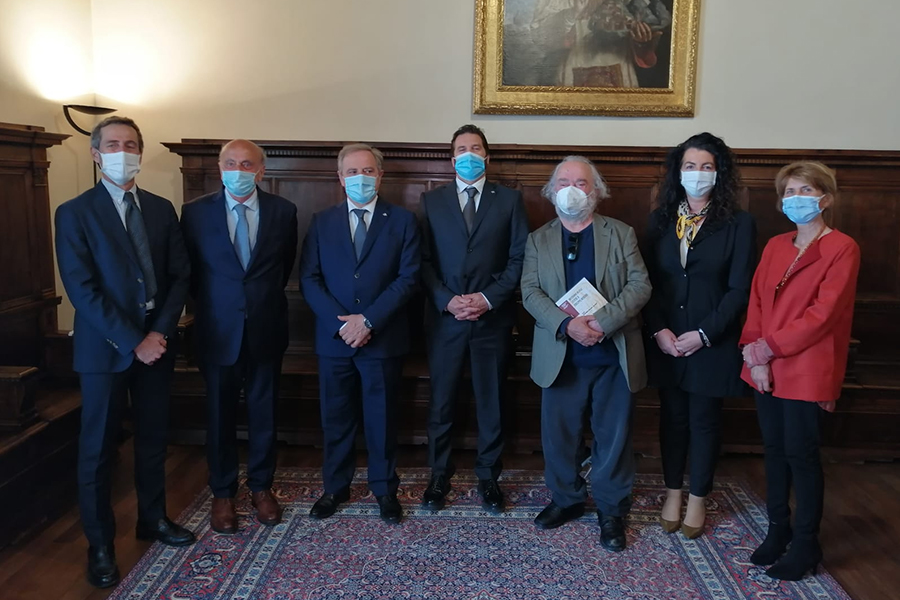
The complete versions of nearly one hundred letters written in the 800th century by philosopher and politician Melchiorre Delfico, author of "Historical Memoirs of the Republic of San Marino," are the focus of the latest book by the Sammarinese Center for Historical Studies of the University of the Republic of San Marino. The volume was presented yesterday, Thursday, May 13, to the Captains Regent Gian Carlo Venturini and Marco Nicolini during an audience at the Palazzo Pubblico.
The text was edited by Girolamo Allegretti, Claudia Malpeli, and Vanna Tabarini, who authored a project that collected 95 letters written between 1804 and 1818. They "came almost all from Naples, where the intellectual from Teramo had been recalled from a long exile in San Marino," which lasted from 1799 to 1806, the three write. The recipient was "Giuseppe Mercuri, a Sammarinese nobleman and brother of the archpriest of Pieve," described as "a good man, well-off, and well-balanced." Among the contents: "news exchanged, small favors, friends from San Marino. And the beloved second homeland in miniature, rugged and hospitable."
Delfico had written the book "Historical Memoirs of the Republic of San Marino" during a period spent on Mount San Marino. Allegretti, Malpeli, and Tabarini emphasize its value both for "the intellectual depth of the author, whose reputation, extending far beyond the confines of Naples, was recognized in Italy and beyond," and for Delfico's extensive commitment. "During his seven years on Mount San Marino," he had participated "heartily in the social life, the walks, the card games, the carnivals, the parties, and the wedding receptions," dedicating "all his energies to studying and writing the history of this, his second and true homeland."
The book, entitled "Melchiorre Delfico – Letters to Giuseppe Mercuri," is part of the activities of the Department of History of the University of San Marino. Present at the presentation, in addition to the heads of state and the curators, were the Secretary of State for Education and Culture, Andrea Belluzzi, and the Director of the Sammarinese Center for Historical Studies, Stefano Pivato.