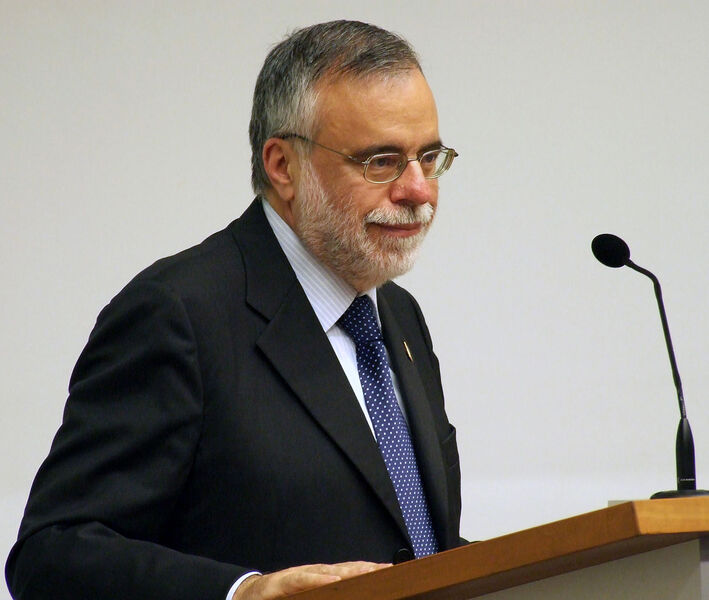
"I will have the opportunity to present the reality of our language's role as a vehicle for culture, and I would even say a way of life and addressing the challenges of today's globalization." These are the words with which Andrea Riccardi, president of the Dante Alighieri Society, begins his address, offering a preview of the keynote lecture he will give during the inauguration ceremony for the 2021–22 academic year at the University of the Republic of San Marino.
The historian, former Italian Minister for International Cooperation and Integration, and founder of the Community of Sant'Egidio, outlines in his answers to three questions the framework for a keynote address he will deliver to academics, students, institutional representatives, and others. The event will be held on Tuesday, October 19th, from 3:00 PM at the Kursaal Congress Center.
The title of his lecture is a question: is there a 'world' in Italian?
Yes, I answer with conviction: in recent years, I've noticed the appeal of our language, even among people of non-Italian origin. I coined the term "Italsimpatia" (Italian sympathy) to express an interest in Italian, the fourth most studied language in the world after English, Spanish, and Chinese, yet the twenty-first most spoken. This interest also extends to culture, art, music, and singing—particularly opera, sung in Italian around the world—as well as food, design, fashion, and much more: in short, a fascination with the "Italian way of life."
In what context does your intervention take place?
The global world represents a revolution, not only in communications or economics, but in politics, life, and relationships. It has brought about a closer world, but not a united one. Indeed, in reaction, many identities have resurfaced: fundamentalisms, nationalisms, and sovereignisms, with a conflictual language. Italian can be a gentle, non-overbearing force, a humane and humanistic proposition, a taste for life together with others.
What areas would you like to explore?
Throughout the history of the 20th century, the Dante Alighieri Foundation has played diverse roles: it was founded in 1889, during the formation of the nation state, founded not on ethnic homogeneity but on voluntary adherence to an identity, in which language played a decisive role. At the time, Italy was not linguistically "one." Tullio De Mauro states that with unification, only 600.000 out of 25 million spoke Italian. There was also the challenge of holding together those "pieces" of Italianness, constituted by emigrants throughout the world... those "millions of lost Italians" to whom the Dante Alighieri Foundation looked. The mission of the Dante Foundation—at the beginning of these 130 years—has been, in various contexts, to connect those "pieces of the homeland" beyond its borders, but now it is above all about cultivating and promoting the Italian language and culture throughout the world. It is the idea of an Italian world larger than Italy: today the reality of around 400 Committees and schools around the world.
What does the invitation from the University of San Marino and the awarding of the PhD degree in Historical Sciences represent?
The Republic of San Marino has a special relationship with the Dante Alighieri Society and its headquarters in the prestigious Renaissance Palazzo Firenze in Rome, formerly the residence of the Medici family. Indeed, the San Marino ambassador regularly participates in the Society's Central Council. I also feel connected to San Marino for very personal reasons related to my childhood in Romagna. In recent years, collaboration on humanitarian and cooperation initiatives has enriched the dialogue between San Marino and the Community of Sant'Egidio, in which I am personally involved. I therefore feel honored and at home in San Marino. Honored to be awarded a Doctorate in Historical Sciences by the prestigious university, and at the same time close and friendly to one of the oldest independent states, with a history of peace, inclusion, and dialogue that perfectly embodies the ideals that the Dante Alighieri Society lives and promotes.