The San Marino University's Emigration Research Center participates in the tenth edition of the DiMMi (Multimedia Migrant Diaries) competition.
Five hundred testimonies from people arriving in Italy from over 50 different countries, collected over ten years of activity. This is the scope of the DiMMi (Multimedia Migrant Diaries) competition, through which since 2012 the memoirs of individuals of foreign origin who live or have lived in Europe have been selected. The initiative is supported by the University of the Republic of San Marino, which is part of the scientific committee in collaboration with other organizations. Along with the University of San Marino's Emigration Research Center, which includes the Emigrant Museum, located in the historic center of San Marino, the project involves over 40 partners, with the support of the Tuscany Region.
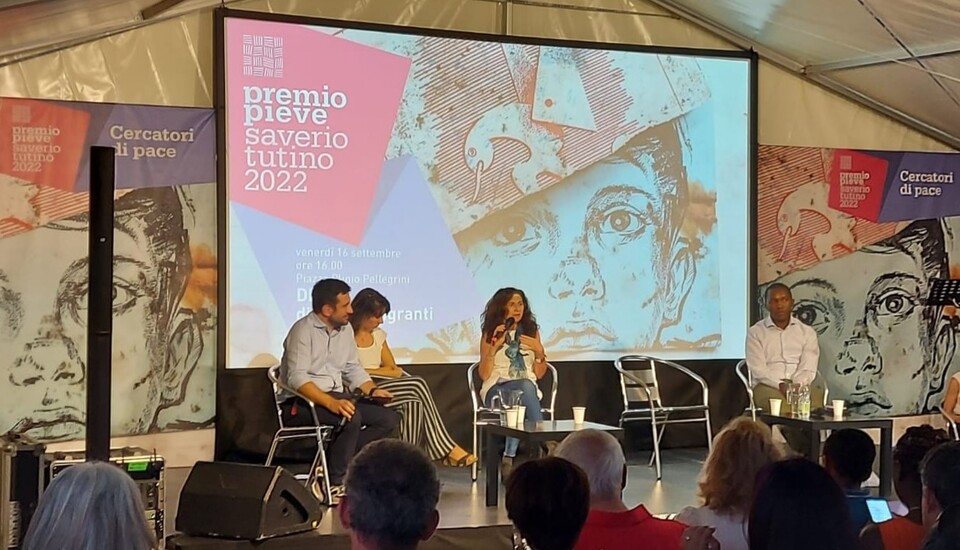
The 2022 edition of the competition took place on September 16 and 17 in Pieve Santo Stefano, in the province of Arezzo, in the presence of the selected authors and with the presentation of the volume containing the 2021 winning texts, entitled "Come alberi in cammino," with sixteen stories published by Terre di Mezzo Editore.
As part of the Pieve Saverio Tutino Award, organized by the National Diary Archives, in addition to participating in initiatives related to the DiMMi project, Patrizia Di Luca, director of the Emigration Research Center at the University of San Marino, has strengthened her existing relationship with the National Museum of Italian Emigration (MEI) in Genoa, a three-story facility divided into 16 sections in the Ligurian capital. "Together with curator Nicla Buonasorte, we have confirmed the projects already underway and reaffirmed our intention to continue sharing materials such as documents, research, and stories, as well as organizing conferences that could be held on Mount Titano in 2023."
This builds on the initiatives already underway, including the DiMMi project: "Meetings with authors," explains Di Luca, "are important because in this way the written words acquire a face and a voice. The texts entered in the competition recount the various motivations, fears, and hopes that accompany the decision to emigrate. They take us into the emotional lives of the protagonists. Through their perspectives and their experiences, we gain a deeper understanding of contemporary migration."