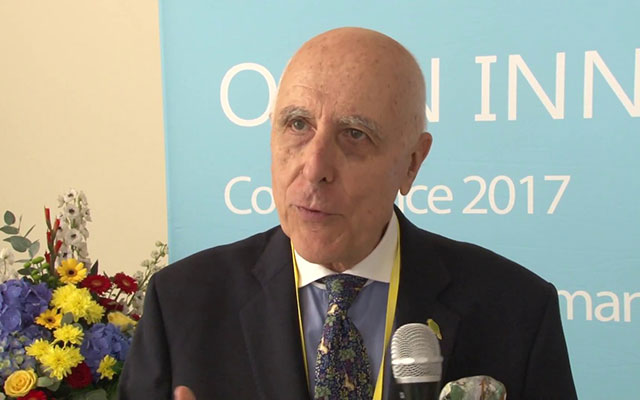
What are the foundations for building tomorrow's universities and fostering innovation? This is the question Piero Formica, professor of Knowledge Economics and researcher at Maynooth University in Ireland, will answer during the international conference "Updating Values," hosted by the University of the Republic of San Marino and co-curated with the University of Bologna and their respective Design degree programs. The objective: to analyze current trends and hypothesize future ones in Design education.
The academic himself, who will speak at the symposium scheduled at the Kursaal Congress Centre on January 16th and 17th alongside academics from countries such as the United States and the United Arab Emirates, offers a preview of his talk, scheduled for 15:30 pm on Thursday, outlining the framework within which a line of thought he describes as "dangerous, and precisely for this reason it is never discussed in Italy."
Where should we start to hypothesize the University of tomorrow?
Not by a reform, but by a revolution. The Italian reality is characterized by great specializations and, at most, interdisciplinarity. This has created wells of knowledge, while simultaneously excluding the possibility of studying very different subjects and, above all, combining them. A random example: business economics and poetry. This is called transdisciplinarity. Universities need transdisciplinary programs, not just interdisciplinary ones. In Japan, there are experimental schools where they teach students to construct sentences with words from different languages. Subject in English, verb in French, and so on, to increase students' creative potential. A different example, from further back in time: in 1836, a reverend working in Maynooth, the community where I am a researcher, invented the induction coil. His name was Nicholas Callan. He studied theology and physics. Many great scientists have fused different disciplines.
What is the purpose of the model you propose?
Making us capable of being innovators again. Let's think about it: how many disruptive innovations in Have anything in recent decades come from Italy? Little or nothing, apart from Piaggio's Vespa and the discoveries on the stereospecific polymerization of GGiulio Natta, Nobel Prize winner in Chemistry in 1963. The reason: we focus on improving what already exists—so-called incremental innovation—to improve what we already know how to do. Instead, we need to seek new and unexplored paths. That's why my message is: Leave your knowledge at home, venture into the unknown, and discover new things. No one does that. Not even startups. Most of them follow in the footsteps of existing, successful businesses.
Are there any operational or even cultural limitations at the moment?
The latter certainly exist. Another example. If a young man had a vision, a project, and his parents had €250 to invest, they would tell him: put your dreams aside and buy a house with this money. In the United States, perhaps, they would instead encourage him to use this money for his own ideas. Broadly speaking, this happened, for example, with Jeff Bezos, the founder of Amazon. Although things aren't that simple. In any case, a complete change in mentality is needed. I'll also discuss this during my speech in San Marino.