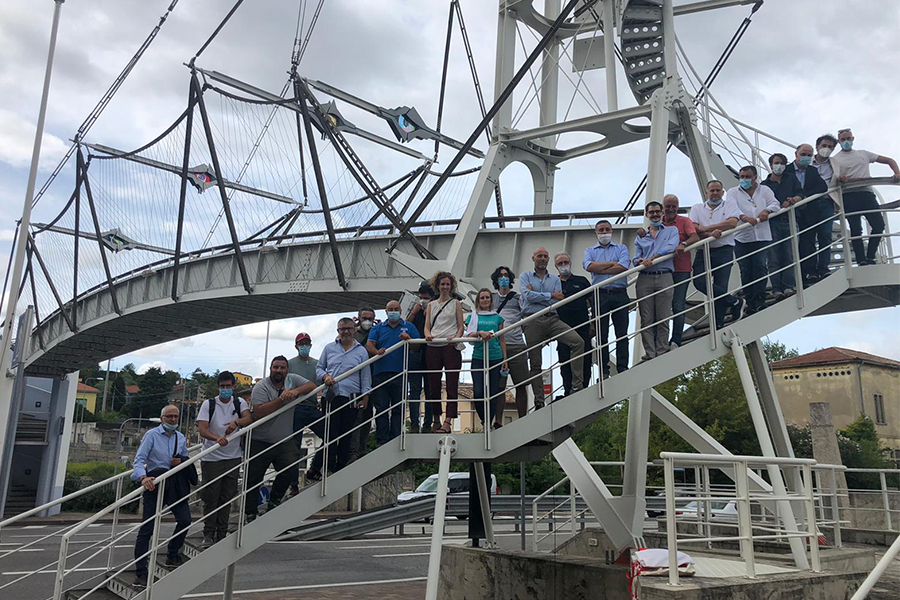
How do the most up-to-date techniques work to understand if a property has suffered damage that is not visible to the naked eye and is it necessary to intervene? This is the question answered by the course "Fundamentals of dynamics, experimental and operational modal analysis of structures", taught by the Civil Engineering degree course of the University of the Republic of San Marino. The initiative was developed over 24 hours of activity and concluded yesterday, Wednesday 5 August, with a field exercise involving tests on the pedestrian walkway at Dogana, on the border with Italy. The training program provided the necessary elements to carry out reliable assessments of structural safety and to plan any seismic upgrading and reinforcement interventions for 22 professionals, including engineers and architects, from places such as Teramo, Ravenna, Viterbo, Frosinone, Naples, Sondrio, Potenza, Treviso, Turin, Assisi and Mantua.
"Dynamic monitoring has acquired an important role in recent years both in the panorama of scientific research and in the professional field", explains the teacher Francesca Dezi, scientific director of the course. “The monitoring of existing civil structures and infrastructures, in fact, is of considerable importance for the assessment of damage following exceptional events, degradation phenomena and static subsidence, as well as for the preparation of maintenance plans. The objective - continues the academic - is to allow the identification of structural changes that are often not identifiable with static monitoring. These solutions offer various advantages: for example, they extend the life cycle of a structure with a consequent economic advantage and fewer risks involved".